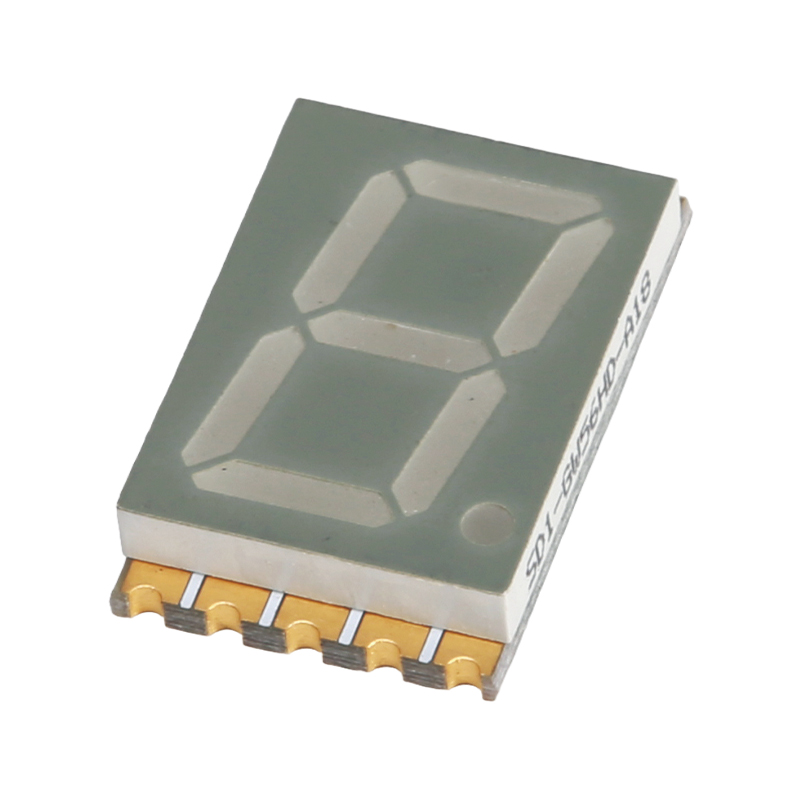
Single-Digit SMD Display: Why It Has Become the “Visual Darling” of the Smart Era
Publish Time: 2025-10-23
In an age where intelligent devices are deeply integrated into daily life—from smartphones and smart homes to automotive dashboards and wearable gadgets—the display has emerged as the central interface for human–machine interaction. Among the many display technologies evolving today, the Single-Digit SMD (Surface-Mount Device) Display stands out as a compact, high-integration, and visually superior solution that is quietly becoming the “visual darling” of the smart era. How does it break through the limitations of traditional display technologies? This article explores its rise through three dimensions: technical principles, application scenarios, and future trends.I. The Technological Core: A Perfect Balance of Miniaturization and High Performance1. SMD Technology: From “Discrete Components” to “Integrated Modules”Traditional LED displays rely on discrete LED bulbs that are manually soldered onto circuit boards. This results in bulky designs, large pixel spacing, and uneven brightness. In contrast, SMD technology integrates the LED chip, lead frame, and encapsulating material into a single package, which is then soldered directly onto the PCB through automated surface-mount processes.This “chip-level packaging” allows pixel sizes to shrink below 0.5 mm, enabling a higher pixel density and dramatically improved resolution. For instance, a 1.5-inch SMD display can support 128×64 pixels, compared to the 32×16 pixels typical of conventional LED panels—delivering finer, smoother visual performance ideal for next-generation smart devices.2. Optical Design: The Evolution from “Point Light” to “Surface Light”The SMD display adopts a flip-chip structure, where the LED die is mounted upside-down directly on the substrate. This shortens current paths, reduces resistance losses, and boosts luminous efficiency by over 30%. Additionally, the inclusion of diffusers and anti-reflective coatings in the encapsulation layer transforms individual point light sources into a uniform surface-emitting light, eliminating the “grainy” texture seen in traditional LEDs.The result is a 160° viewing angle and 1000:1 contrast ratio, ensuring high visibility even under bright sunlight—ideal for automotive or outdoor devices. Meanwhile, each pixel consumes as little as 0.1 W, aligning perfectly with the power constraints of portable, battery-driven electronics.3. Driving Scheme: From “Static Scanning” to “Dynamic Refreshing”Traditional LED modules rely on static scanning, which limits refresh rates (typically below 60 Hz) and causes flickering or ghosting. SMD displays overcome this through dynamic row-column scanning controlled by integrated driver ICs, achieving refresh rates above 240 Hz.This improvement not only removes motion blur but also supports multi-level grayscale (16 to 256 levels), allowing the display of dynamic icons, animations, or even video content. In a smartwatch, for example, an SMD display can smoothly render animated fitness data—something impossible on older static LED panels.II. Application Scenarios: From “Functional Display” to “Intelligent Interaction”1. Consumer Electronics: Small Screens, Big ImpactIn smartphones, wearables, and other compact devices, the Single-Digit SMD display has redefined micro-display performance. Take smartwatches as an example: traditional segmented LED screens can only show basic data like time and step count, while a 1.2-inch full-color SMD display supports heart rate graphs, notification icons, and customizable watch faces.Its ultra-thin 2.8 mm profile (versus over 5 mm for older screens) leaves more room for batteries and sensors, achieving both slimmer design and longer endurance. Moreover, its ultra-low standby power consumption (under 5 mW) extends the battery life of smart bands from 7 to 15 days, a major competitive edge in the market.2. Automotive Electronics: A Dual Leap in Safety and IntelligenceAutomotive applications represent another frontier for SMD displays. Traditional dashboards rely on mechanical dials with small LCD inserts, which limit data visualization and responsiveness. The SMD display, however, can be embedded into steering wheels, center consoles, or even HUD (Head-Up Display) systems.With brightness levels exceeding 1000 nits and anti-reflective coatings, it ensures crystal-clear visibility under direct sunlight—perfect for speed, navigation, and alert indicators. For example, the Tesla Model 3 uses a 7-inch SMD full-color screen capable of displaying real-time energy flow and voice-command feedback.Furthermore, its -40°C to 85°C operating range and ISO 16750-certified vibration resistance enable reliable performance under extreme conditions, making it a cornerstone of intelligent automotive safety systems.3. Industrial Control: Precision Displays Empowering ProductivityIn industrial automation, the SMD display distinguishes itself with high reliability and strong customization capability. Traditional industrial panels often use numeric tubes or small LCDs with limited flexibility and high maintenance costs. In contrast, SMD screens support multi-language menus, dynamic flowcharts, and remote monitoring.For instance, a 4.3-inch SMD touchscreen integrated into a PLC (Programmable Logic Controller) can display system status, fault codes, and operational guidance in real time, improving production efficiency by up to 40%. Its IP67 waterproof/dustproof rating and built-in ESD protection also ensure durability in dusty or humid environments—making it the “visual nerve system” of Industry 4.0.III. Future Trends: Toward Flexibility, Intelligence, and Ecosystem Integration1. Flexible Displays: From “Flat Panels” to “Curved Interfaces”Today’s SMD displays use rigid PCBs, limiting their deployment in curved or wearable designs. With the development of PI (polyimide) flexible substrates and micro-LED chips, SMD technology is evolving toward flexibility.Samsung, for example, has demonstrated a bendable 1.4-inch full-color SMD display with a bending radius of just 5 mm—ideal for smart bracelets and AR glasses. Mass adoption of flexible SMD screens will drive a shift in consumer electronics from “functional devices” to “wearable art.”2. Intelligent Interaction: From “Display” to “Perception”Next-generation SMD displays will integrate various sensors to create unified “display + interaction” systems. By embedding pressure sensors, they will support force-sensitive touch (e.g., light tap for switching interfaces, firm press for confirmation). With ambient light sensors, they can automatically adjust brightness to save energy, and with micro-cameras, they can enable under-display facial recognition and gesture control.This transformation—from passive display to proactive perception—will elevate smart devices into active companions. For instance, a smart speaker with an SMD screen could provide visual feedback to voice commands, significantly enhancing user engagement.3. Ecosystem Integration: From “Isolated Components” to “Collaborative Systems”As 5G and IoT technologies mature, the SMD display will evolve into a core node of smart ecosystems. In smart homes, it can serve as a control hub, connecting via Wi-Fi 6 or Bluetooth 5.3 to lighting, HVAC, and security systems for one-touch automation. In smart cities, it can be embedded in streetlights or bus stops to display traffic data, environmental metrics, and advertisements, forming an urban “visual neural network.”Through such integration, SMD displays will transcend their hardware role to become interactive platforms, driving the transformation of display technology toward scenario-based intelligence.Small Screen, Big FutureThe rise of the Single-Digit SMD Display reflects a broader evolution from function-driven to experience-driven display technology. Its miniaturization, high performance, and strong adaptability resolve the contradiction between “limited space” and “limitless demand” in modern smart design.As flexible, intelligent, and ecosystem-based technologies continue to mature, SMD displays will redefine what a “display” means—not merely as a medium for information, but as the visual brain that enables smart devices to perceive, understand, and interact with the world.In this ongoing display revolution, the SMD technology has already proven one truth:Even the smallest component can shine the brightest light.